
Online Gambling Market Demand, Industry Analysis Report, 2026 - 2034
REPORT DETAILS
Online Gambling Market Summary
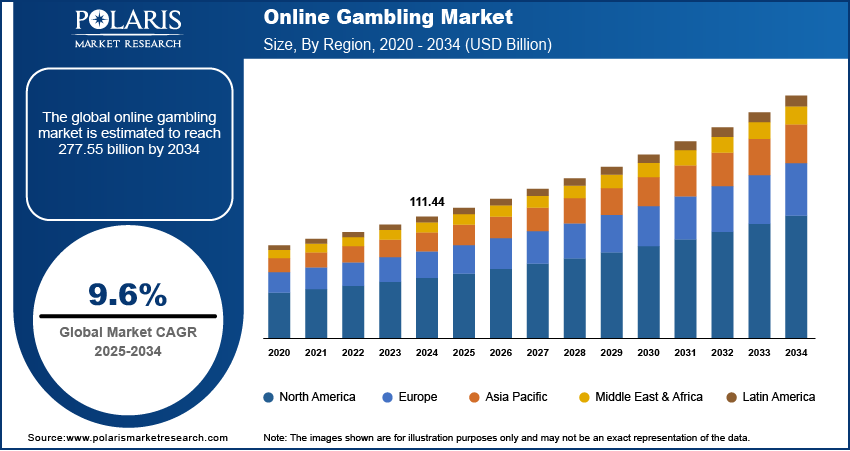
The online gambling market size was valued at USD 121.96 billion in 2025, exhibiting a CAGR of 9.6% during 2026–2034. The market is fueled by growth in internet and smartphone penetration, mobile and 5G technology developments, growing legal and regulatory backing, and continuous innovations among gambling operators and technology suppliers.
Market Statistics
Key Takeaways
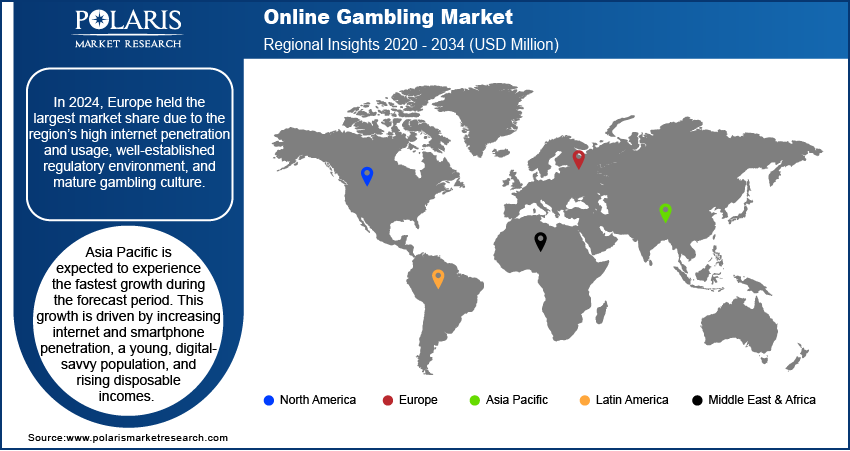
- Europe held the largest revenue share in the market in 2025 at 49.80%. This is owing to the presence of an established regulatory framework and well-rooted gambling culture.
- Asia Pacific is expected to grow at the highest CAGR of 10.0% over the forecast period. The growing prevalence of the internet and smartphones has propelled the market growth in the region.
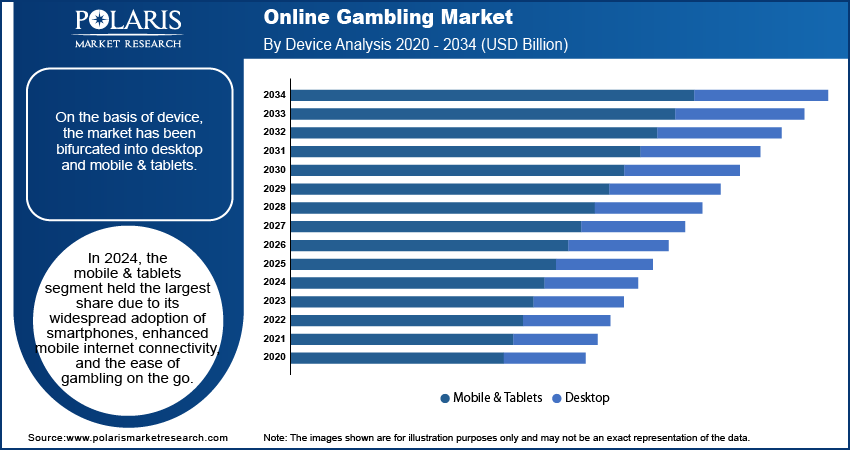
- The mobile & tablets segment held the largest revenue share in the market in 2025 at 61.0%. This is attributed to improved connectivity via mobile internet and the adoption of smartphone devices.
- The sports betting segment held the largest market share of 35.69% in 2025. The widespread popularity of sports has enabled sports betting to maintain its largest share in the market.
- The others segment, including casinos, is expected to register a CAGR of 27.0% over the forecast period. This growth will be attributed to the growing use of innovative technologies such as AR and VR to enhance the gambling experience.
Note: Figures and projections outlined in this report are the result of Polaris Market Research’s proprietary analytical processes, grounded in the latest available datasets and market observations.
Industry Dynamics
- Technological advancements have profoundly changed the market by enhancing access and enriching user experiences.
- Growing internet penetration and ubiquitous use of mobile phones have emerged as major growth drivers of the online gambling market.
- Governments are introducing disciplined regulatory schemes to leverage the tax revenue and employment-generating potential of online gambling, thus increasing demand through the provision of a more transparent and secure environment for participants.
- Stringent regulations and regulatory uncertainties in many regions stifle expansion in the online gambling industry.
AI Impact on Online Gambling Market
- AI is enhancing the user experience in internet gambling by providing personalized recommendations to players based on their behavior and preferences.
- Machine learning technologies are enhancing fraud prevention and security protocols, making transactions and gameplay even safer for users.
- Artificially intelligent chatbots and virtual assistants are making customer support more efficient, providing faster and more effective resolution of player problems.
- AI-powered predictive analytics enable online gambling sites to forecast user behavior and streamline marketing efforts.
To Understand More About this Research:Download Sample Report
Online gambling refers to internet-based wagering activities that encompass sports betting, online casinos, poker, and emerging formats like eSports betting and virtual sports. It enables players to engage in real-money gambling through desktops, mobile apps, and smart devices, offering unparalleled convenience compared to traditional land-based venues.
The market has undergone significant transformation due to technological advancements, which have improved accessibility and enhanced user experiences. Key factors propelling the global online gambling market are gambling operators, software developers, payment service providers, and regulatory bodies, as they collectively drive market growth by expanding service offerings, enhancing platform functionality and security, streamlining payment processes, and fostering a more transparent and trustworthy environment that attracts and retains users.
What is the Regulatory Landscape of the global online gambling market?
The market landscape is governed by various regulatory frameworks, ranging from fully licensed and taxed markets to jurisdictions with stringent prohibitions. Many countries maintain differentiated rules for online sports wagering versus casino gaming. Also, several countries follow state- or province-level governance. The table below provides the summary of the regulatory stance across key regions. It is expected to guide stakeholders for market entry and compliance planning.
| Country | Online sports betting | Online casino / iGaming | Key notes |
| U.S. | Yes (state-by-state) | Yes (limited, state-by-state) | Sports betting is legal in many states (regulated per state) Online casino legality varies by state Operators must use geolocation and state licenses |
| Canada | Yes (provincial) | Yes (provincial/offshore) | Federal Criminal Code governs gambling; provinces control licensing/operations — mix of provincial-run sites and private operators Rules vary by province |
| UK | Yes (regulated) | Yes (regulated) | The UK Gambling Commission provides licensing and strong consumer-protection rules, such as age checks, affordability checks, and marketing rules |
| Germany | Yes (regulated) | Yes (regulated under Interstate Treaty) | Interstate Treaty on Gambling (Glücksspielstaatsvertrag) modernized online licensing (sports betting, poker, virtual slots) with multi-year licenses. |
| Japan | Limited / tightly controlled | Generally prohibited | Japan allows limited legal betting (e.g., certain public sports). However, online casino gaming remains effectively prohibited |
| China (Mainland) | Prohibited | Prohibited | Bans on online gambling Players often access offshore sites via VPNs (illegal) Hong Kong / Macau differ |
| India | Mixed/state control; evolving (2025 law changes) | Mixed / state control; evolving | Gambling is regulated at the state level 2025 national legislation (Promotion & Regulation of Online Gaming Act) and state actions (e.g., Tamil Nadu) are reshaping permissible real-money games |
| South Africa | Yes (online sports betting via licensed bookmakers) | Online casino is largely prohibited (interactive gambling) | Betting (sports) is permitted online via licensed bookmakers Interactive online casino gaming is largely not allowed — provincial regimes apply. Recent court rulings and enforcement clarified limits |
| UAE | Historically prohibited; shifting regulatory experiments | Historically prohibited; limited licensed projects | Gambling is illegal under Sharia-based law. However, the UAE established a federal gaming regulator and has begun selective licensing for commercial gaming (e.g., resort projects) |
Source: Polaris Market Research Analysis
Types of Online Gambling
| Type | What It Involves | Why Users Prefer It |
| Sports Betting | Betting on outcomes of sports events | Real-time engagement and wide variety of sports |
| Online Casino Games | Slots, blackjack, roulette, and similar games | Easy to play and quick results |
| Online Poker | Players compete against each other | Requires skill and strategy |
| Lottery & Instant Games | Draw-based or instant win formats | Low cost with high payout potential |
| Esports Betting | Betting on competitive gaming events | Popular among younger, digital users |
Source: Polaris Market Research Analysis
Payment Ecosystem and User Behavior
Payment systems have a significant impact on the user experience on online gambling websites. Most gambling websites provide various ways of payment, such as using debit or credit cards, digital wallets, bank transfer systems, and even cryptocurrencies in some cases. The speed and reliability of the transaction become critical factors for a platform selection.
Modern users need quick payments and fast withdrawals because delays can negatively affect trust. Online gambling sites that ensure a reliable, smooth financial transaction process retain their clients longer. Moreover, mobile usage has altered user behavior because most people use gambling platforms via their smartphones and expect easy and secure operations. Finally, security and confidentiality have also become crucial factors, as users prefer to use websites that offer a safe payment system.
Market Dynamics
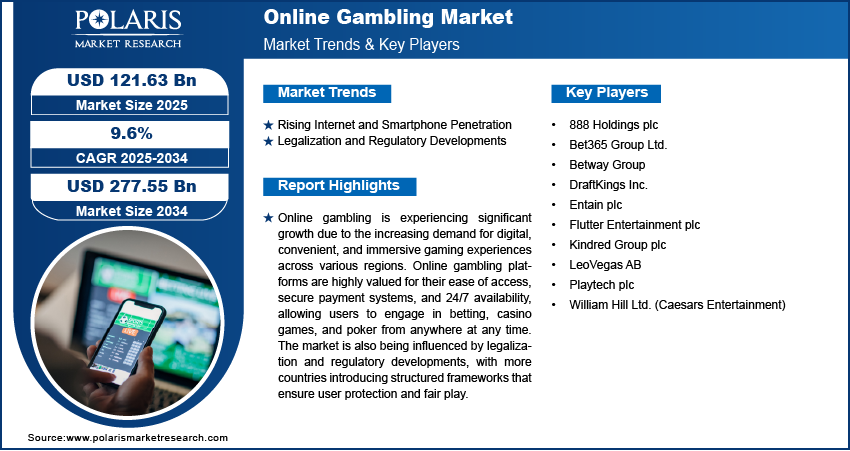
Rising Internet and Smartphone Penetration
The rising penetration of internet connectivity, coupled with the widespread use of smartphones, has emerged as a key online gambling market growth driver. According to the data published by DemandSage in December 2024, over 5.3 billion people worldwide had access to the internet, with mobile devices accounting for more than 90% of all internet users. This proliferation has democratized access to online gambling, allowing users in both urban and rural settings to participate in activities such as sports betting, online casinos, poker, and lotteries from the convenience of their smartphones.
The integration of 5G technology has significantly enhanced the user experience by enabling high-speed, low-latency connections. This is an important factor for live casino games and real-time sports betting. For instance, Betway and 888 Holdings have reported increased engagement from mobile platforms, attributing this trend to smoother video streaming and faster transaction speeds powered by advanced mobile networks. Additionally, as per the International Research Journal of Modernization in Engineering Technology and Science (IRJMETS), cricket-based gaming platforms like Dream11 and MPL (Mobile Premier League) have grown rapidly in popularity due to the sport’s significance in Indian culture, widespread smartphone adoption, and affordable data costs. As a result, widespread internet access, affordable smartphones, and next-gen mobile networks continue to fuel the rapid expansion and adoption of online gambling.
Legalization and Regulatory Developments
Online gambling is gaining significant traction as more countries introduce legalization measures and establish regulatory frameworks. Governments have recognized the potential of the online gambling industry to generate tax revenue and create jobs, driving them to implement structured regulatory frameworks. These efforts are boosting demand for online gambling by offering players a safer and more transparent environment. For example, in the US, states like New Jersey, Michigan, and Pennsylvania have legalized various forms of online gambling, resulting in billions in revenue and a surge in market share. According to the Pennsylvania Gaming Control Board, revenue from gaming rose to USD 529 million in January 2025, a 10.88% increase over the previous year. Pennsylvania is one of the seven states that allow iGaming, enabling users to play their favorite casino games such as blackjack, poker, and roulette online. The other eligible states include Connecticut, Delaware, Michigan, New Jersey, Rhode Island, and West Virginia.
Similarly, Latin America is becoming one of the most strategically important regions for online gambling. Countries such as Colombia, Brazil, Mexico, Peru, and Argentina have moved to regulate their online gambling markets, opening doors for international operators and boosting growth in the region. In India, the online betting space, especially fantasy sports platforms like Dream11, has gained traction as certain states begin to ease restrictions. These legal reforms have created a more investor-friendly environment, thereby driving market growth.
Segment Insights
Market Assessment – By Device
On the basis of device, the market has been bifurcated into desktop and mobile & tablets. In 2025, the mobile & tablets segment held the largest share of 74.50% due to the widespread adoption of smartphones, enhanced mobile internet connectivity, and the ease of gambling on the go. Over the past decade, users have increasingly preferred mobile platforms over traditional desktops, as mobile devices offer smooth, user-friendly interfaces and features like real-time notifications and personalized gaming experiences. This trend is particularly evident in Asia Pacific, where players show a strong preference for mobile gaming due to affordable mobile data plans. Additionally, the growing availability of mobile-optimized platforms has contributed to the segment’s dominance, especially in emerging markets.
Market Evaluation – By Type
On the basis of type, the market has been segmented into sports betting, poker, bingo, and others. In 2025, the sports betting segment held the largest share of 35.64% due to its strong global appeal, high-frequency user engagement, and increasing legalization in several key regions. The popularity of sports such as football, cricket, basketball, and tennis has contributed to rising user participation, especially during major tournaments like the FIFA World Cup, IPL, and NBA playoffs. As more countries regulate online sports betting, the demand for online gambling continues to grow, driven by greater trust in licensed platforms. This trust, combined with the interactive nature of betting on live events, has expanded the overall online gambling market share. Moreover, partnerships between betting platforms and major sports leagues are helping to boost user engagement and brand visibility. For instance, companies like Betway, Bet365, and William Hill sponsored some of the premier soccer clubs and leagues in Europe. Betway has been the principal partner of West Ham since 2015, logos of which are seen on the players’ uniforms and the club’s stadium in London.
Regional Analysis
By region, the study provides the online gambling market insights into North America, Europe, Asia Pacific, Latin America, and the Middle East & Africa. In 2025, Europe held the largest market share of 49.80% due to the region’s high internet penetration and usage, well-established regulatory environment, and mature gambling culture. European countries such as the UK, Germany, Italy, France, and Spain have adopted both online and offline gambling, offering clear legal frameworks that promote safe and transparent operations. The presence of leading global operators such as Bet365, Kindred Group, and William Hill has also strengthened the region’s market through innovation, trust, and continuous investment in technology.
Asia Pacific is expected to experience the fastest growth during the forecast period at a CAGR of 10.0%. This growth is driven by increasing internet and smartphone penetration, a young, digital-savvy population, and rising disposable incomes. Countries such as India, the Philippines, and Thailand are experiencing a rapid surge in online betting and casino game participation due to favorable demographics and growing access to digital payment systems. The region’s strong passion for sports, mainly for cricket, football, and eSports, has further fueled demand. In India, platforms like Dream11 and MPL have seen exponential user growth due to the rising popularity of fantasy sports linked to real-time sporting events.
Key Players and Competitive Insights
The online gambling market is highly competitive, driven by the increasing demand for seamless, secure, and accessible gaming experiences across both urban and rural regions. Key players in the industry are focusing on developing advanced platforms that offer enhanced user interfaces, real-time gaming, and personalized content to attract and retain users. Companies are heavily investing in research and development (R&D) to improve platform performance, security features, live streaming capabilities, and mobile responsiveness. Major players in the market include Bet365 Group Ltd.; 888 Holdings plc; Betway Group; LeoVegas AB; Flutter Entertainment plc; Entain plc; William Hill Ltd.; DraftKings Inc.; Playtech plc; and Kindred Group plc.
Bet365 Group Ltd. is a privately owned online gambling company headquartered in England. Founded in 2000, Bet365 has grown into one of the world’s leading online betting platforms, offering sports betting, online casino, poker, bingo, and live streaming services. The company operates in multiple international markets and is licensed by several major regulatory bodies, ensuring compliance and trustworthiness. Known for its user-friendly mobile app and advanced live betting features, Bet365 serves millions of users globally. It continues to invest in technology, customer service, and responsible gambling initiatives. Despite its scale, the company remains family-run, and is recognized for its strong financial performance and commitment to innovation in the online gambling space.
William Hill Ltd. (888 Holdings) is a British online and retail gambling company founded in 1934. Headquartered in London, it is known for its strong presence in sports betting, particularly horse racing and football, along with online casino and poker offerings. The company has transitioned successfully into the digital space, becoming a major player in online gambling. William Hill operates under multiple licenses, including those in the UK, Gibraltar, and several US states. The brand continues to grow through technological upgrades, mobile integration, and a strong commitment to responsible gaming while maintaining its iconic status in the global gambling industry.
List of Key Companies
- 888 Holdings plc
- Bet365 Group Ltd.
- Betway Group
- DraftKings Inc.
- Entain plc
- Flutter Entertainment plc
- Kindred Group plc
- LeoVegas AB
- Playtech plc
- William Hill Ltd. (Caesars Entertainment)
Online Gambling Industry Developments
-
March 2026: DraftKings Inc. outlined its expanded growth strategy. The company also announced increased deployment of AI across the platform and revealed plans to launch a super app, “DraftKings Sports & Casino.” (Source: businesswire.com)
- July 2025: Evolution signed an exclusive agreement with Hasbro to create and offer online casino games based on popular brands like Monopoly, Clue, and Battleship. This deal grew Evolution’s branded game lineup and reinforced its strong position in live casino gaming. (Source: evolution.com)
- April 2025: Caesars extended its partnership with AGS to launch the Triple Coin Treasures slot games online for the first time. Caesars’ online casinos became the only platforms offering these popular titles in several U.S. states, including New Jersey and Pennsylvania. (Source: caesars.com)
- September 2024: EveryMatrix launched LoyaltyEngine, a cross-vertical suite of tools empowering operators to strengthen the bond between players and brands, significantly boosting player engagement, retention, and lifetime value. (Source: everymatrix.com)
- July 2024: Boomerang Bet became the official regional betting partner of AC Milan in Europe. This partnership signifies Boomerang's strategic move to enhance its brand presence in the European market. (Source: acmilan.com)
Online Gambling Market Segmentation
By Type Outlook (Revenue, USD Billion, 2021–2034)
- Sports Betting
- Poker
- Bingo
- Others
By Device Outlook (Revenue, USD Billion, 2021–2034)
- Desktop
- Mobile & Tablets
By Regional Outlook (Revenue, USD Billion, 2021–2034)
- North America
- US
- Canada
- Mexico
- Europe
- Germany
- France
- UK
- Italy
- Spain
- Netherlands
- Rest of Europe
- Asia Pacific
- China
- Japan
- India
- South Korea
- Indonesia
- Rest of Asia Pacific
- Middle East & Africa
- Saudi Arabia
- UAE
- South Africa
- Israel
- Rest of Middle East & Africa
- Latin America
- Brazil
- Argentina
- Rest of Latin America
Online Gambling Market Report Scope
| Report Attributes | Details |
| Market Size Value in 2025 | USD 121.96 Billion |
| Market Size Value in 2026 | USD 133.52 Billion |
| Revenue Forecast by 2034 | USD 279.29 Billion |
| CAGR | 9.6% from 2026 to 2034 |
| Base Year | 2025 |
| Historical Data | 2021–2024 |
| Forecast Period | 2026–2034 |
| Quantitative Units | Revenue in USD Billion and CAGR from 2026 to 2034 |
| Report Coverage | Revenue Forecast, Market Competitive Landscape, Growth Factors, and Industry Trends |
| Segments Covered |
|
| Regional scope |
|
| Competitive Landscape |
|
| Report Format |
|
| Customization | Report customization as per your requirements with respect to countries, regions, and segmentation. |
Source: Polaris Market Research Analysis
Online Gambling Market FAQ's
The global market size was valued at USD 121.96 billion in 2025 and is projected to grow to USD 279.29 billion by 2034.
The global market is expected to register a CAGR of 9.6% during the forecast period.
Europe held the largest share of the global market in 2025.
A few key players in the market are Bet365 Group Ltd.; 888 Holdings plc; Betway Group; LeoVegas AB; Flutter Entertainment plc; Entain plc; William Hill Ltd.; DraftKings Inc.; Playtech plc; and Kindred Group plc.
The mobile & tablets segment dominated the market in 2025.
Download Sample Report of Online Gambling Market
Please fill out the form to request a customized copy of the research report.


